Bernard Ginelli
The knifemaker of Prehistory, flintknapping expert.
In a few words...
His passion for prehistory came very early, and it could be said, like a famous character, that "he fell into it as a child." With curiosity, experimentation and chance encounters, Bernard became, over the years, one of the finest flintknappers in the world, training a whole generation of professionals as well as a great many enthusiasts. Although entirely self-taught, for twenty years he played a genuine role in cultural outreach and worked closely with several scientific teams.
The origins of a passion
Bernard Ginelli was born on December 11, 1947 in Tamniès, in the Dordogne region of France, and grew up on a small family farm. His discovery of archaeology came through the flint tools scattered across the farm's fields. During frequent visits to the Castel Merle museum in Sergeac, René Castanet, the museum's owner and a friend of his parents, regularly entrusted him with the keys and passed on his passion for prehistoric humankind.
Bernard then began a long search for worked pieces surfacing in the fields, which allowed him to build a substantial collection requiring a solid typological approach. Between the ages of 25 and 30, he made occasional attempts at flintknapping, then, with a group of friends, created a museum introducing visitors to prehistory in Tamniès.
The Tamniès museum
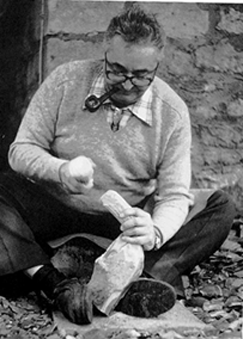
The museum was inaugurated in 1974 by Professor François Bordes, who, surprised by the quality of the reproductions, invited Bernard for a private lesson. From this meeting came a new fascination — this time for the material itself: flint. Harder than steel, notoriously temperamental, and with a cutting edge that rivals the finest steel blades!
Bernard developed his knapping skills alongside American teams who came to excavate the Abri Pataud in Les Eyzies. His work was recognized by these archaeologists, and Bernard's reputation soon crossed the Atlantic.
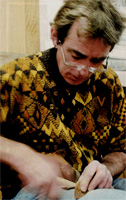
1988, a decisive turning point
In 1988, Bernard decided to stop farming to devote himself full-time to flintknapping. The idea of a knife with a flint blade and a deer-antler handle was born. The discovery of the Çatalhöyük knife (Turkey, -8000 years) and then the Gebel el-Arak knife (Egypt, -3500 years, on display at the Louvre) confirmed he was on the right path.
In March 1989, a meeting with a journalist from the French magazine "Connaissance de la Chasse" and the resulting article brought him his first orders, notably from the Kindal cutlery house in Paris. In 1990, Bernard opened a flintknapping workshop in Les Eyzies: PALAIOS.
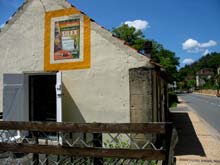
PALAIOS, the Les Eyzies workshop
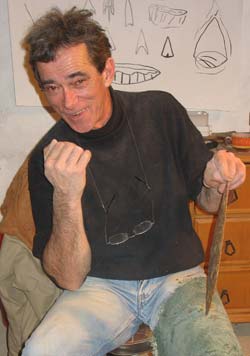
In his workshop, Bernard devoted himself almost exclusively to making knives. Most French and foreign archaeologists who visited the workshop offered him valuable insight. He regularly gave commentated knapping demonstrations, both for the general public and for the scientific research community, speaking notably at the Solutré Museum and the University of Neuchâtel.
Milestones reached by 1998: Late Neolithic dagger blades (from "livre de beurre" cores), Solutrean laurel-leaf blades, Predynastic Egyptian knife blades, and type III and IV Scandinavian daggers.
Back to his roots
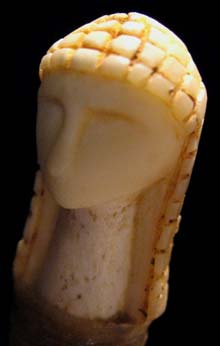
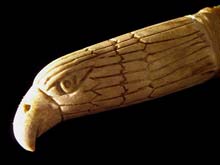
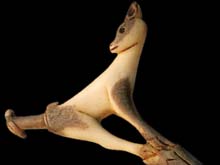
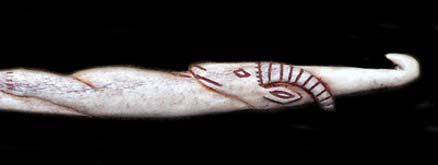
Closed in 2000 and reopened on April 1, 2008, PALAIOS once again welcomed the curious and the passionate to this haven of prehistory: Les Eyzies-de-Tayac, a major tourist destination in the Périgord Noir region (45 avenue de la Préhistoire, facing the Abri Pataud). Bernard continued creating magnificent pieces and turned his attention to the beauty of knife handles through sculptures inspired by prehistoric art (the Venus of Brassempouy, the Bison of Niaux, a reptile, a horse, a human face...).
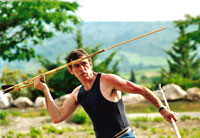
A keen practitioner of prehistoric target shooting from early on, Bernard was also runner-up European atlatl-throwing champion in 2004, and European champion in 2005. He took second place again in 2006 and also ranked in the world top 10 of the ISAC (International Standards Accuracy Championship).