The Chalcolithic knife
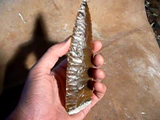
The most detailed reduction sequence on the site: around 4.5 hours of work to bring a flint-bladed, antler-handled knife to life, from the preform to the final edge test.
The parts of the knife
The blade is produced through bifacial retouch, in the style of the Orgnac l'Aven knives or the famous Ötzi knife. The handle is carved from antler (deer or reindeer). It is attached using a tar-based glue or pine resin and birch-bark pitch, along with deer-sinew ligatures soaked in rabbit-skin glue.
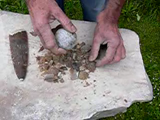
Phase 1 — Knapping the preform
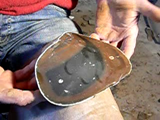
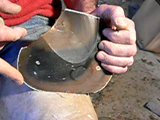
The blade is roughed out by percussion, controlling how shock waves travel through the flint until a regular preform is achieved.
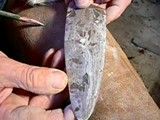
Phase 2 — Polishing
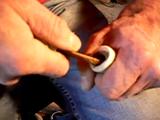
Using a sandstone wheel with "potée" (polishing powder) as an abrasive, polishing takes about 2.5 hours: it erases the flake scars and prepares the surface for the final retouch.
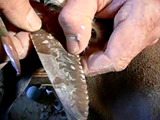
Phase 3 — Pressure flaking
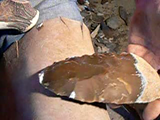
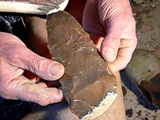
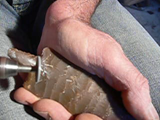
Using a copper-tipped pressure flaker, each flake is detached under roughly 30 kg of pressure, to refine the edge and even out the sides of the blade.
The handle and the ligatures
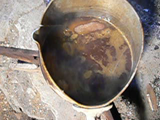
The handle is then shaped: drilling, notching, grinding. The blade is fixed to it with a glue made of pine resin (70%) and beeswax (30%), then with rabbit-skin glue and deer-sinew ligatures.
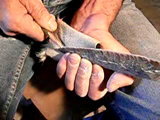
Does it actually cut?
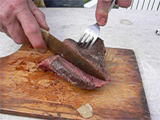
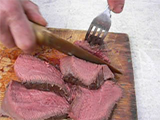
The finished knife is put to the test on meat — the best way to check that all this work paid off.
The steps in pictures